A Twisted Path
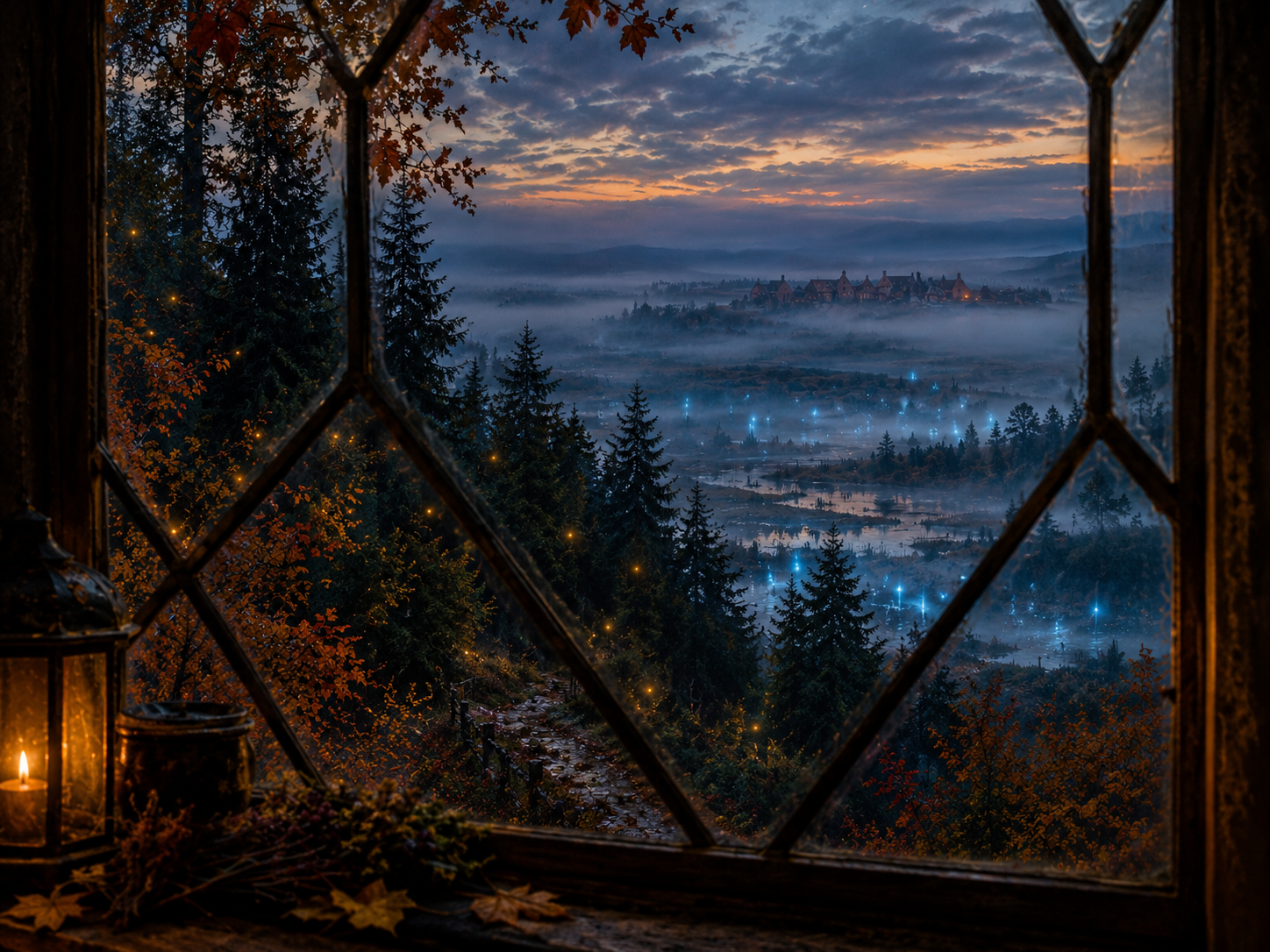
Sit, love. No, not in the visitor’s chair. Over here, by the hearth, where the heat can find your knees and keep you warm. Where the window bends the world like gems.
Do you hear the marsh singing? I heard the curlew last night and the night before so keep your feather close. Look through the glass. Those lights are coming across the water, one by one, the way they do on this night and no other. You have watched them since you were small and I told you it was marsh-fire. I told you a great many things.
Tonight I will tell you the true things. My hands are nearly done, so you will need to know them all in their turn.
You know the story. Everyone does. A starving family, a father who lost his nerve, a stepmother with a cold heart, the forest, a house of sweets. A wicked witch, a clever girl, an oven. You were told it as a lullaby, and you were told it with particular care, because it was also your own.
You believe you were left in the woods at the age of six because there was no bread. You said so once, in a fever, and never again. You still wake some nights with the shape of a woman walking away printed behind your eyes.
That woman was not your mother.
Nor was the man beside her your father. You were taken long before, from a village somewhere along the coast, a place I could not find on a map. You were carried across the marsh to a village that stands in this world only one night in the year, and there you were raised as their own. They taught you your prayers. They sat you on a knee. For years they were kind to you, and they meant every kindness, and that is the part I cannot forgive. A child who has been loved cries more convincingly when she is left.
They left you where the edge of the marsh is swallowed by ancient trees, tall and black as coal. They told you to walk into the trees where it was safe, and follow an old road while they looked for food. They said they would return soon and left you with a crust of bread and the lie. You walked the road to my door. I know the road. It is the only one that leads here, and it is haunted because I have made it so.
Let me tell you what they believe.
They believe that if the witch in the woods goes unfed, they will be erased. Not killed. Unmade, house by house, as though they had never been, and every true child of theirs slaughtered in the unmaking. So they steal children from the countryside and seacoasts around them and fatten them on affection and leave them at my threshold. Their own are safe. It is only ever someone else’s child who is given up for eating.
They believe that unspeakable things happen in this house. You’ve heard it said. Rooms that cannot be described aloud, a bed of knives, a garden of what I have made of the children. The old stories will hang a great many horrors on one cottage if you let them.
Of course there are no such rooms. There is a table and a cupboard of honey and the bed you have slept in since you were six. There is the room where a sick child may be tended with bars on the door so they come to no harm. There is a fire in the oven that I keep roaring, and pokers I leave to burn white in the coals, because the lanterns across the marsh can see our chimney, and a fire that size tells them everything they need to hear. A tale as such travels fast and lives forever.
Sixty years I have counted the children. A hundred and nine, if you are asking.
I fed them honey and bread. I taught them a name that was not their own and sewed it into their hems. In the grey before dawn I walked each one to the old drovers’ road and pointed toward a farm, a convent, a cousin in some far town. I told them not to speak of this house, nor of the village that brought them, because the men would know they were alive and would surely find and kill them.
I could not send them home. I did not know where home was and their parents never came looking. Only the village knows, and the village will never tell. So you see, I can save them, but I cannot give them back.
There was a boy once, who came to this door the same winter I did. Berta fed him, nursed him back to health and put him on the drovers’ road like the rest. I never learned where it led him, but he was handsome and kind and I was sorry to see him go. I sewed Hans into his shirts.
Do you know the name I was given at that door? I will tell you, and you will understand why I say what I am about to say. It was Gretel.
It is not my name. It was never my name. It is what the woman before me was called, and the woman before her, and it is what you will be called when I am under the lilac. Gretel is the girl who is chosen. Gretel is the one who is groomed. Gretel is the one who keeps the fire and wears the monster so that the rest may walk out alive.
I thought, when Berta told me, that it was an honour. I was eight. I would have believed anything that came with a gentle hand on my shoulder.
Here is the worst of it, and I will say it once.
I do not know if they are right.
I do not know if the village would truly vanish if the witch went hungry. I would think not since I have never eaten a child, but in sixty years I have never gone hungry, nor been brave enough to find out otherwise. Every Samhain they cross the marsh with their lanterns, and every year I hold the story together with my teeth, because I cannot prove it false and I cannot bear to learn that it was true.
And there is the other thing. The men.
They are not all rescuers who come in the night. In fact, a rescuer has come only once. Most will come to confirm the offering was eaten, and they must never leave this house with the truth. Any man who crosses my threshold may be one of theirs, and so he is offered tea. Nobody refuses a hot cup at the edge of a marsh. It comes from the jar behind the blue cup on the high shelf. Use Berta’s recipe, and a man who has drunk it does not fight. Half and he sleeps as dead. A girl of nine could not wrestle a grown man into an oven, and I have never had to. The fire is for the lanterns to see. What comes after is for the pigs and the geese out back, which have never once gone hungry. Be sure to look away.
You know, I have not always been able to tell them apart. There may have been a lost hunter, once. Another a pedlar who only wanted shelter. I carry them. You will learn the weight of it, and you will not put it down.
I tell you so you understand what is being asked. I will not lie to you the way they lied to me.
Listen.
There. The knock.
That is tonight’s. They leave one on the step at the edge of dark, crying for a mother who is not hers. I know the sound better than my own heartbeat. Don’t go yet. Hear me finish.
My hands will not close around the poker any longer. You saw it last winter, though you were kind enough to say nothing. The fire has been burning hotter these last years because I could not do the lifting. I need you to take it.
And I made my own cup tonight, before you came in from the garden. The blue cup. Don’t look at me like that. It is gentler than anything I have given others, and it is mine to drink. By the time the men reach the door — if they come at all tonight — I will be a warm weight in the visitor’s chair, which is where I ought to be. The way of it is written behind the honey, in Berta’s hand and in mine, along with my name. Keep it close. You will need it decades from now, when there is a child at your own hearth and your hands no longer close.
Berta said the same to me, in this room, on a night like this one. I was nine years old and I wanted my mother and I said yes, and I have never in my life been certain whether that was courage or just the last thing a frightened child had left to give.
I won’t ask you to be certain. I will only ask you what I was asked. Will you stand between the children and the lanterns?
The lights have reached the edge of the marsh. I can hear the water.
Here is the poker. Take it by the cooler end. It will not burn you until you have decided to burn.
Good. Now go to the door.
When you open it you will find a small thing draped in an old shawl, with a face already ruined by crying. She will be sure she has been abandoned. Let her be. The truth is for later.
For now there is only one thing you need to say. Say it gently. Say it the way it was said to me, and to the girl before me, and to the girl before her, back as far as anyone has counted. It was the kindest sentence I was ever given, and it is also a lie. Home is the one thing none of us can ever give back.
Say it anyway. You are lost no more. Welcome home, child.
Behind you, the oven roars, washing the walls in shimmering butterscotch.
Behind the child, the path twists into the dark, fireflies sparking between the trees and flashing pale blue before dying in the distant marsh.
Watch for any that turn. If they hold steady or wink as they twist in the night, like owl eyes, they are not fireflies.
And Gretel, always leave the poker where they can see it.
“Yes, ma’am.” The girl rose from the chair by the hearth, crossed the room to the heavy wooden door and drew back the latch.
Leave a Reply