The Dark Harbours
Nell had been laying out the dead of Caladh a’ Chlèibh for almost thirty years, and she was not afraid of them. She knew their weight, the way a jaw wants tying, the small cold sighs from a body that asks for nothing anymore. But if she were being truthful, the more startling eruptions could still take her by surprise. She also knew how often the living could be wrong. Twice she had stopped a burial at the church door. It was said in Caladh a’ Chlèibh that nobody went into the ground until Nell MacLean had put a glass to them, and in all this time Nell had never once let anyone by her without it.
She kept the glass in her apron pocket always, a round of mirror no bigger than a crown, rimmed in tin.
It was the living who frightened her. The living clawed at her, wanting things.
Ailsa took sick on the 29th day of October. Her head felt warm at supper, then came the cough. Nell did what she knew: willow bark, vinegar cloths, the window cracked for air. By morning, Ailsa’s fever was milder, and the cough had lessened. Her neighbour, Peg MacIssac, came to the door with a posset in a blue cup, honey and milk and something green steeped through it, and stood on the step with her shawl pulled over her mouth as if the sickness were a smell.
“I could hear her through the wall, poor thing. This’ll cool her and help the cough,” Peg said. “My mother always swore by it.” Nell took it gratefully from her and set it by the cupboard for later. Ailsa was finally sleeping and she didn’t want to wake her. Instead, Nell slipped into the back garden to clip fresh herbs for soup.
The cough returned later in the afternoon, rapidly followed by fever.
Nell grabbed the cup from the cupboard and held it to Ailsa’s lips until she swallowed. It was bitter, and Ailsa made a face. Nell was so glad of the face, so glad that the child still had it in her to disapprove, that she did not think to smell the cup herself. She set it on the sill and did not look at it again.
The second night passed much like the first. The hours that followed gave brief reprieves and it seemed the fever was fading, the coughing not as harsh.
On the third night, which was the last day of October, Nell woke to find the cottage lit from within. Was it dawn already?
The light was thin and blue-white, the colour of skimmed milk, and it hung at the foot of the bed like a flame without a wick. Ailsa lay beneath it, cheeks burning, her breath coming short and shallow.
Nell froze as an old memory surfaced. It was her grandmother’s voice, rough and reedy, the voice people use for things they only half believe, saying, “Before a death, the corpse candle comes. It leaves the house and walks the road the coffin will walk, and it never takes a wrong turn.”
The light drifted to the door. She felt her own breath suck sharply back inside her chest. All Nell could do was watch, horrified, as the latch lifted though no hand touched it, and the light left the house. This was enough to shake her loose from the stupor and her bare feet hit the floor. She followed, across the room, through a faint drift of lamp oil by the door, and over the threshold. Her heart was still a stone in her chest as she watched the light go down the lane. She knew where it would go. At the crossroads every funeral in Caladh a’ Chlèibh turned left, up the hill road to the church.
The candle turned right.
It took the shore path.
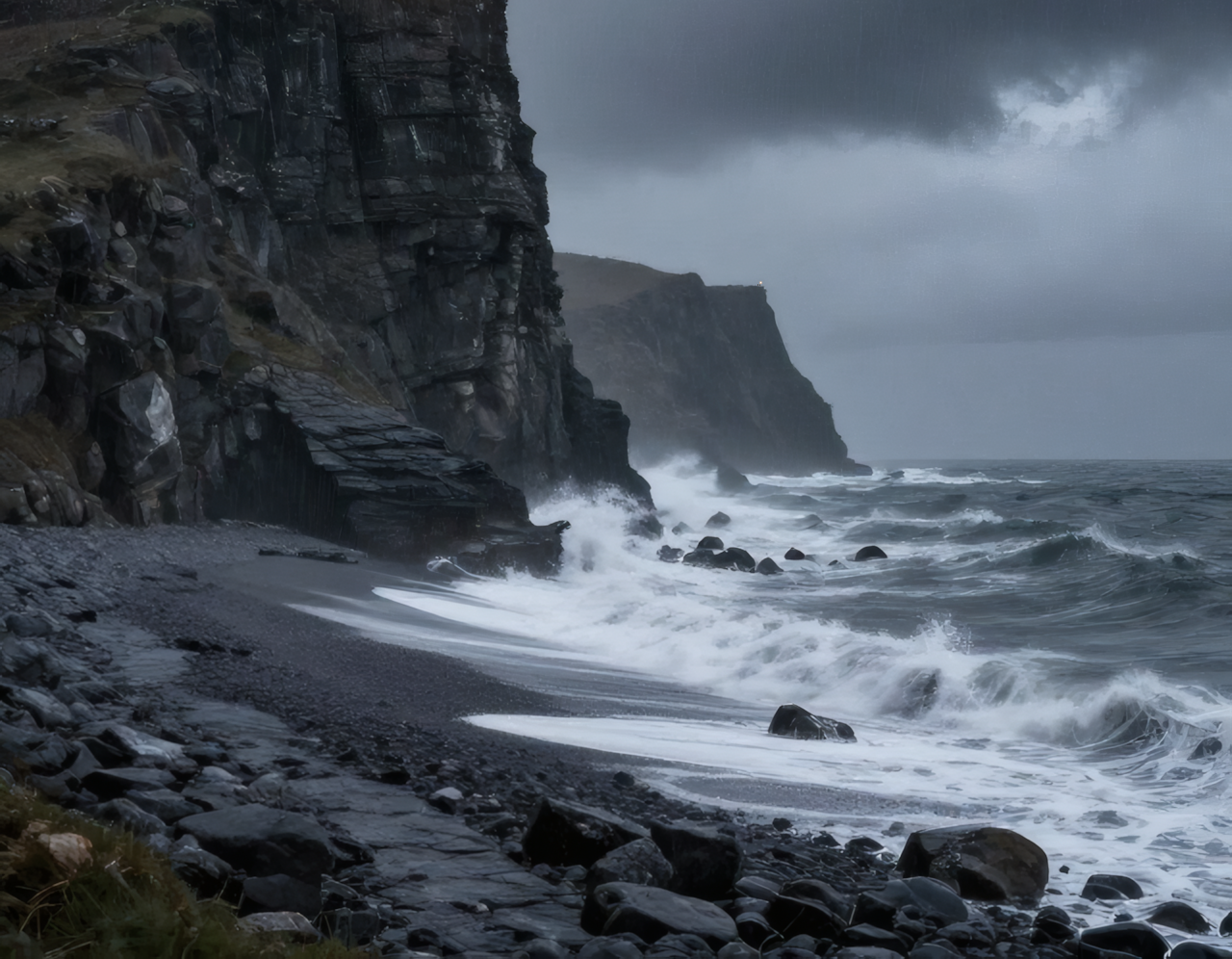
Nobody carried the dead along the shore unless they’d come from the sea. The path ran below the cliffs where the water came in over the rocks twice a day, and even at low tide it was a bad road: weed-slick, narrow, cut by a channel the old people called the Throat. The candle bobbed along it, patient and pale, until it disappeared into the distance, behind the cliff with the stair that climbed to the churchyard.
Nell stood in the lane until her feet were numb. She was sure she’d understood what she’d been shown, and it felt like a gift and a trap at once. The candle had given her the road. A road could be refused. If no coffin ever went down the shore path, the candle would have lied, and her grandmother’s stories would be only stories.
She went back inside, gathered her daughter into a blanket, and eased the rim of the blue cup between her daughter’s lips.
By afternoon, the fever had climbed again, and Ailsa no longer knew her mother’s face. The powder man lived four miles inland by the high road, and the high road was a river of mud after three days of rain. Nell knew it would be long dark before she reached him, and the child couldn’t wait.
The shore path would have them there in an hour or two.
She stood at the crossroads with Ailsa in a woollen sling bound at her waist and shoulder, a sturdy walking stick in hand, and the wind pulling at her skirts. To her left, the hill road climbed toward the church. To her right, the shore path glittered with wet stone, waiting. Doors had begun to open along the lane.
“Nell!” called Peg from her gate. “Don’t!”
“The tide’s out,” Nell shouted. “I have ’til the turn.”
“Isn’t the tide I’m afraid of!” Peg was almost shrieking now.
“Sure the light’s gone left!” Nell’s voice fluttered over the wind as she turned right.
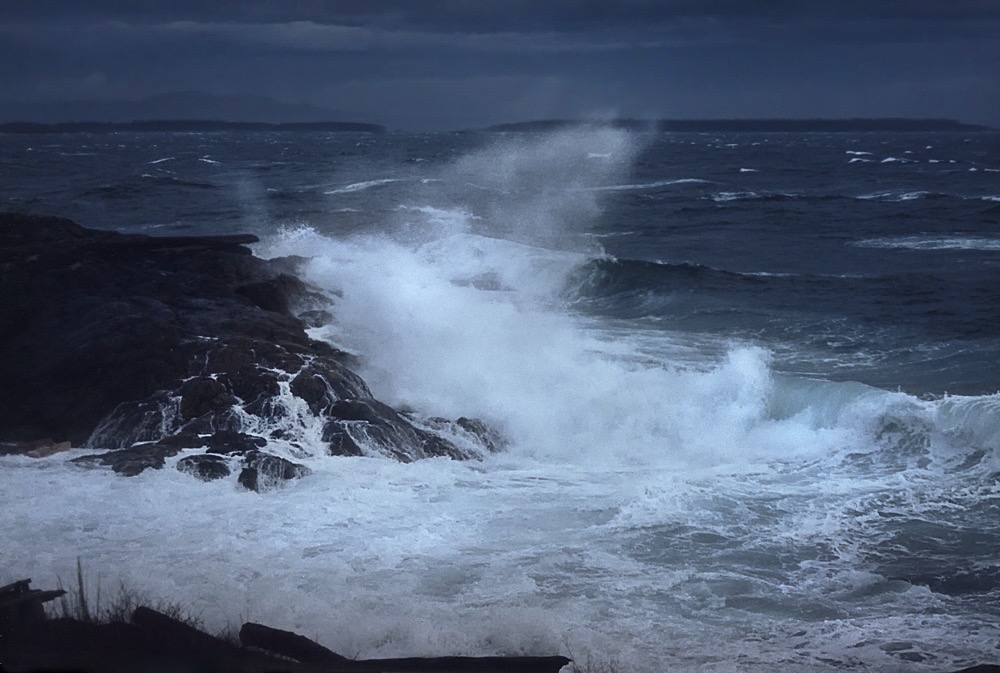
The shore was louder than she remembered, with the sea smashing against the rocks like something enormous heaving in its sleep, and the weed popping and sighing beneath her boots. She walked with her eyes on the rocky beach, her daughter’s weight slung tight against her breast, counting steps to keep her thoughts at bay.
Ailsa had stopped murmuring. Nell told herself it was sleep.
Three hundred forty-six, three hundred forty-seven, three hundred forty-eight.
The church seemed to rise straight out of the cliff ahead. The broken light along the western horizon caught in the corners of the cross above the bell tower and for a moment, a holy shadow flickered a blessing across the turbulence. The Throat, where the water channelled through ragged, oily rocks that jutted from the sea like teeth, gnashing against the incoming tide only to return it almost surreptitiously on the ebb. Back out to sea beyond the rocks, where the wrecks lay deep and silent in their own harbours.
When Nell reached the Throat, the channel was already running, black and fast, thigh-deep and rising. She waded in, clutching the blanket with one hand and jamming the stick between slick rocks with the other. Halfway across, her foot found a hollow and she went down to the waist, catching herself on a rock. A sharp cry. A gull. Wind whipping wet hair across her face, blinding and stinging. Her legs felt numb. Four hundred eighteen. Four hundred nineteen.
As she rose, she felt the bundle in her arms go quiet in a different way.
She did not stop walking, pushing through the cold dark water, sometimes going sideways, stumbling. When she reached the far bank, she pulled the child from the sling and set her on a flat shelf of glistening rock. She put her ear to Ailsa’s mouth, stroking her cheek and then her whole body, as if she could will the blood to flow through her veins and pour her own breath through the child’s cold lips by force. Her hand went inside her coat to her apron. She found the glass, and lifted it, and held it over the small mouth, and the wind took the breath out of it and the light was bad and she could not tell, she could not tell, thirty years of telling and she could not tell.
The sea went on breathing, heaving, sighing.
“No,” Nell said, politely, the way one speaks to a man who has made a clerical error. “No. We took the other road. You said the shore path. We took the shore path, so this is not right…”
Her voice trailed off and stopped.
A pale blue light was resting on the rock beside her daughter’s head.
It did not flicker. She reached for it but her hand went through it. There was no warmth in it, nor on the stone beneath it. It waited, with the terrible courtesy of a creditor who has come to the right door at last. The truth crept over her, crystallizing in her veins. It was cold, final.
The candle had not shown her where Ailsa would be carried.
It had shown her where Ailsa would die.
It had not been a warning. It had been a map, and the one woman in Caladh a’ Chlèibh certain to follow it was the one who had tried hardest to refuse. Every step of her refusal had been a step along the road. She had not outrun the candle. She had walked it faithfully, with her daughter in her arms, and the light had only needed to wait at the end of the line she drew for it.
She put the glass back in her pocket without looking at it again. She did not know, then or ever, whether it had shown her anything at all.
They came down — the men — to the cliff stair with lanterns freshly lit, as if somebody had told them where to be. Nell sat on the bottom step with the blanket across her knees, holding it the way she had once held it at the christening, and she did not look up when they came.
Peg MacIssac put out a hand. “Nell. Give her to us.”
“I took the wrong road.”
“There’s no wrong road, child. There’s only the one.”
“I should put the glass to her again. I’m the one who does the glass.”
“You’ve done it,” Peg said, gently. “I saw you. Let us, now.”
The men lifted the small shape from her arms and wrapped it in a fresh blanket. They carried it up the steep, rocky steps. Up and up to the churchyard, where a grave stood open, dug before anyone had thought to send for a spade. The earth was dry and fresh. Nell thought, The sexton never dug it. The sexton was in his bed with a fever. But she said nothing, because by then it was too late for the question to matter, and because her hands were cold, and because a mother is not supposed to be the one who checks.
The priest read the words quickly and the wind took them out to sea. When the first handful of earth struck the board, Nell found that she was standing a little apart from the others, at the edge of the lamplight, and that the light beside her was not a lantern.
She watched it for some time.
Long after the village had gone down the hill in twos and threes, not looking back, the light stayed. It did not follow her. It rested among the stones above the new grave, blue and still and faintly lit with something like moonlight. It gave no warmth and no direction. It only stayed as a person stays who is waiting for everyone else to leave.
Nell looked at it a long while. Then, because there was nothing left to do, she turned for home.
She took the hill road, the right road down, the way every funeral walks in Caladh a’ Chlèibh.
Five hundred thirty-one, five hundred thirty-two. Five hundred thirty-three.
The lane was empty. Every window was shuttered, and no dog barked. Her cottage waited at the end of it, dark, with its door standing a little ajar.
She was twenty paces from her own gate when she heard it.
From behind the house, in the black shadows of the garden, the sound of a latch. A careful sound, small and muffled, the way a latch lifts under the hand of someone who knows the house and has no wish to be heard. Then it fell back once into its keeper, and was still.
Leave a Reply