
Category: Prose

  • The Dark Harbours

    The Dark Harbours

    The Dark Harbours

    Nell had been laying out the dead of Caladh a’ Chlèibh for almost thirty years, and she was not afraid of them. She knew their weight, the way a jaw wants tying, the small cold sighs from a body that asks for nothing anymore. But if she were being truthful, the more startling eruptions could still take her by surprise. She also knew how often the living could be wrong. Twice she had stopped a burial at the church door. It was said in Caladh a’ Chlèibh that nobody went into the ground until Nell MacLean had put a glass to them, and in all this time Nell had never once let anyone by her without it.

    She kept the glass in her apron pocket always, a round of mirror no bigger than a crown, rimmed in tin.

    It was the living who frightened her. The living clawed at her, wanting things.

    Ailsa took sick on the 29th day of October. Her head felt warm at supper, then came the cough. Nell did what she knew: willow bark, vinegar cloths, the window cracked for air. By morning, Ailsa’s fever was milder, and the cough had lessened. Her neighbour, Peg MacIssac, came to the door with a posset in a blue cup, honey and milk and something green steeped through it, and stood on the step with her shawl pulled over her mouth as if the sickness were a smell.

    “I could hear her through the wall, poor thing. This’ll cool her and help the cough,” Peg said. “My mother always swore by it.” Nell took it gratefully from her and set it by the cupboard for later. Ailsa was finally sleeping and she didn’t want to wake her. Instead, Nell slipped into the back garden to clip fresh herbs for soup.

    The cough returned later in the afternoon, rapidly followed by fever.

    Nell grabbed the cup from the cupboard and held it to Ailsa’s lips until she swallowed. It was bitter, and Ailsa made a face. Nell was so glad of the face, so glad that the child still had it in her to disapprove, that she did not think to smell the cup herself. She set it on the sill and did not look at it again.

    The second night passed much like the first. The hours that followed gave brief reprieves and it seemed the fever was fading, the coughing not as harsh.

    On the third night, which was the last day of October, Nell woke to find the cottage lit from within. Was it dawn already?

    The light was thin and blue-white, the colour of skimmed milk, and it hung at the foot of the bed like a flame without a wick. Ailsa lay beneath it, cheeks burning, her breath coming short and shallow.

    Nell froze as an old memory surfaced. It was her grandmother’s voice, rough and reedy, the voice people use for things they only half believe, saying, “Before a death, the corpse candle comes. It leaves the house and walks the road the coffin will walk, and it never takes a wrong turn.”

    The light drifted to the door. She felt her own breath suck sharply back inside her chest. All Nell could do was watch, horrified, as the latch lifted though no hand touched it, and the light left the house. This was enough to shake her loose from the stupor and her bare feet hit the floor. She followed, across the room, through a faint drift of lamp oil by the door, and over the threshold. Her heart was still a stone in her chest as she watched the light go down the lane. She knew where it would go. At the crossroads every funeral in Caladh a’ Chlèibh turned left, up the hill road to the church.

    The candle turned right.

    It took the shore path.

    Nobody carried the dead along the shore unless they’d come from the sea. The path ran below the cliffs where the water came in over the rocks twice a day, and even at low tide it was a bad road: weed-slick, narrow, cut by a channel the old people called the Throat. The candle bobbed along it, patient and pale, until it disappeared into the distance, behind the cliff with the stair that climbed to the churchyard.

    Nell stood in the lane until her feet were numb. She was sure she’d understood what she’d been shown, and it felt like a gift and a trap at once. The candle had given her the road. A road could be refused. If no coffin ever went down the shore path, the candle would have lied, and her grandmother’s stories would be only stories.

    She went back inside, gathered her daughter into a blanket, and eased the rim of the blue cup between her daughter’s lips.

    By afternoon, the fever had climbed again, and Ailsa no longer knew her mother’s face. The powder man lived four miles inland by the high road, and the high road was a river of mud after three days of rain. Nell knew it would be long dark before she reached him, and the child couldn’t wait.

    The shore path would have them there in an hour or two.

    She stood at the crossroads with Ailsa in a woollen sling bound at her waist and shoulder, a sturdy walking stick in hand, and the wind pulling at her skirts. To her left, the hill road climbed toward the church. To her right, the shore path glittered with wet stone, waiting. Doors had begun to open along the lane.

    “Nell!” called Peg from her gate. “Don’t!”

    “The tide’s out,” Nell shouted. “I have ’til the turn.”

    “Isn’t the tide I’m afraid of!” Peg was almost shrieking now.

    “Sure the light’s gone left!” Nell’s voice fluttered over the wind as she turned right.

    The shore was louder than she remembered, with the sea smashing against the rocks like something enormous heaving in its sleep, and the weed popping and sighing beneath her boots. She walked with her eyes on the rocky beach, her daughter’s weight slung tight against her breast, counting steps to keep her thoughts at bay.

    Ailsa had stopped murmuring. Nell told herself it was sleep.

    Three hundred forty-six, three hundred forty-seven, three hundred forty-eight.

    The church seemed to rise straight out of the cliff ahead. The broken light along the western horizon caught in the corners of the cross above the bell tower and for a moment, a holy shadow flickered a blessing across the turbulence. The Throat, where the water channelled through ragged, oily rocks that jutted from the sea like teeth, gnashing against the incoming tide only to return it almost surreptitiously on the ebb. Back out to sea beyond the rocks, where the wrecks lay deep and silent in their own harbours.

    When Nell reached the Throat, the channel was already running, black and fast, thigh-deep and rising. She waded in, clutching the blanket with one hand and jamming the stick between slick rocks with the other. Halfway across, her foot found a hollow and she went down to the waist, catching herself on a rock. A sharp cry. A gull. Wind whipping wet hair across her face, blinding and stinging. Her legs felt numb. Four hundred eighteen. Four hundred nineteen.

    As she rose, she felt the bundle in her arms go quiet in a different way.

    She did not stop walking, pushing through the cold dark water, sometimes going sideways, stumbling. When she reached the far bank, she pulled the child from the sling and set her on a flat shelf of glistening rock. She put her ear to Ailsa’s mouth, stroking her cheek and then her whole body, as if she could will the blood to flow through her veins and pour her own breath through the child’s cold lips by force. Her hand went inside her coat to her apron. She found the glass, and lifted it, and held it over the small mouth, and the wind took the breath out of it and the light was bad and she could not tell, she could not tell, thirty years of telling and she could not tell.

    The sea went on breathing, heaving, sighing.

    “No,” Nell said, politely, the way one speaks to a man who has made a clerical error. “No. We took the other road. You said the shore path. We took the shore path, so this is not right…”

    Her voice trailed off and stopped.

    A pale blue light was resting on the rock beside her daughter’s head.

    It did not flicker. She reached for it but her hand went through it. There was no warmth in it, nor on the stone beneath it. It waited, with the terrible courtesy of a creditor who has come to the right door at last. The truth crept over her, crystallizing in her veins. It was cold, final.

    The candle had not shown her where Ailsa would be carried.

    It had shown her where Ailsa would die.

    It had not been a warning. It had been a map, and the one woman in Caladh a’ Chlèibh certain to follow it was the one who had tried hardest to refuse. Every step of her refusal had been a step along the road. She had not outrun the candle. She had walked it faithfully, with her daughter in her arms, and the light had only needed to wait at the end of the line she drew for it.

    She put the glass back in her pocket without looking at it again. She did not know, then or ever, whether it had shown her anything at all.

    They came down — the men — to the cliff stair with lanterns freshly lit, as if somebody had told them where to be. Nell sat on the bottom step with the blanket across her knees, holding it the way she had once held it at the christening, and she did not look up when they came.

    Peg MacIssac put out a hand. “Nell. Give her to us.”

    “I took the wrong road.”

    “There’s no wrong road, child. There’s only the one.”

    “I should put the glass to her again. I’m the one who does the glass.”

    “You’ve done it,” Peg said, gently. “I saw you. Let us, now.”

    The men lifted the small shape from her arms and wrapped it in a fresh blanket. They carried it up the steep, rocky steps. Up and up to the churchyard, where a grave stood open, dug before anyone had thought to send for a spade. The earth was dry and fresh. Nell thought, The sexton never dug it. The sexton was in his bed with a fever. But she said nothing, because by then it was too late for the question to matter, and because her hands were cold, and because a mother is not supposed to be the one who checks.

    The priest read the words quickly and the wind took them out to sea. When the first handful of earth struck the board, Nell found that she was standing a little apart from the others, at the edge of the lamplight, and that the light beside her was not a lantern.

    She watched it for some time.

    Long after the village had gone down the hill in twos and threes, not looking back, the light stayed. It did not follow her. It rested among the stones above the new grave, blue and still and faintly lit with something like moonlight. It gave no warmth and no direction. It only stayed as a person stays who is waiting for everyone else to leave.

    Nell looked at it a long while. Then, because there was nothing left to do, she turned for home.

    She took the hill road, the right road down, the way every funeral walks in Caladh a’ Chlèibh.

    Five hundred thirty-one, five hundred thirty-two. Five hundred thirty-three.

    The lane was empty. Every window was shuttered, and no dog barked. Her cottage waited at the end of it, dark, with its door standing a little ajar.

    She was twenty paces from her own gate when she heard it.

    From behind the house, in the black shadows of the garden, the sound of a latch. A careful sound, small and muffled, the way a latch lifts under the hand of someone who knows the house and has no wish to be heard. Then it fell back once into its keeper, and was still.
    Return to Hallowe’en

    Leave a Reply

    Your email address will not be published. Required fields are marked *

  • A Twisted Path

    A Twisted Path

    A Twisted Path

    Sit, love. No, not in the visitor’s chair. Over here, by the hearth, where the heat can find your knees and keep you warm. Where the window bends the world like gems.

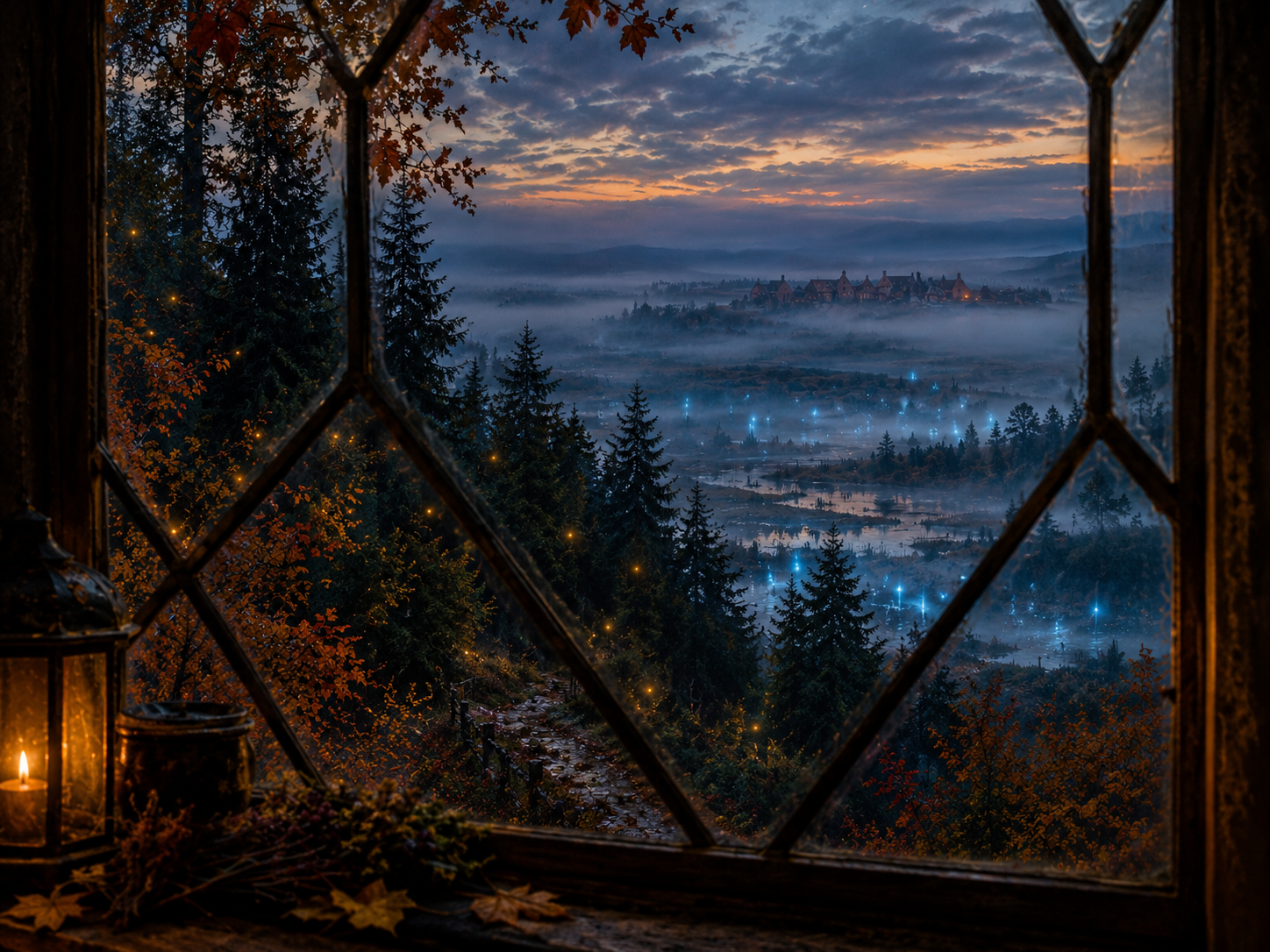
    Do you hear the marsh singing? I heard the curlew last night and the night before so keep your feather close. Look through the glass. Those lights are coming across the water, one by one, the way they do on this night and no other. You have watched them since you were small and I told you it was marsh-fire. I told you a great many things.

    Tonight I will tell you the true things. My hands are nearly done, so you will need to know them all in their turn.

    You know the story. Everyone does. A starving family, a father who lost his nerve, a stepmother with a cold heart, the forest, a house of sweets. A wicked witch, a clever girl, an oven. You were told it as a lullaby, and you were told it with particular care, because it was also your own.

    You believe you were left in the woods at the age of six because there was no bread. You said so once, in a fever, and never again. You still wake some nights with the shape of a woman walking away printed behind your eyes.

    That woman was not your mother.

    Nor was the man beside her your father. You were taken long before, from a village somewhere along the coast, a place I could not find on a map. You were carried across the marsh to a village that stands in this world only one night in the year, and there you were raised as their own. They taught you your prayers. They sat you on a knee. For years they were kind to you, and they meant every kindness, and that is the part I cannot forgive. A child who has been loved cries more convincingly when she is left.

    They left you where the edge of the marsh is swallowed by ancient trees, tall and black as coal. They told you to walk into the trees where it was safe, and follow an old road while they looked for food. They said they would return soon and left you with a crust of bread and the lie. You walked the road to my door. I know the road. It is the only one that leads here, and it is haunted because I have made it so.

    Let me tell you what they believe.

    They believe that if the witch in the woods goes unfed, they will be erased. Not killed. Unmade, house by house, as though they had never been, and every true child of theirs slaughtered in the unmaking. So they steal children from the countryside and seacoasts around them and fatten them on affection and leave them at my threshold. Their own are safe. It is only ever someone else’s child who is given up for eating.

    They believe that unspeakable things happen in this house. You’ve heard it said. Rooms that cannot be described aloud, a bed of knives, a garden of what I have made of the children. The old stories will hang a great many horrors on one cottage if you let them.

    Of course there are no such rooms. There is a table and a cupboard of honey and the bed you have slept in since you were six. There is the room where a sick child may be tended with bars on the door so they come to no harm. There is a fire in the oven that I keep roaring, and pokers I leave to burn white in the coals, because the lanterns across the marsh can see our chimney, and a fire that size tells them everything they need to hear. A tale as such travels fast and lives forever.

    Sixty years I have counted the children. A hundred and nine, if you are asking.

    I fed them honey and bread. I taught them a name that was not their own and sewed it into their hems. In the grey before dawn I walked each one to the old drovers’ road and pointed toward a farm, a convent, a cousin in some far town. I told them not to speak of this house, nor of the village that brought them, because the men would know they were alive and would surely find and kill them.

    I could not send them home. I did not know where home was and their parents never came looking. Only the village knows, and the village will never tell. So you see, I can save them, but I cannot give them back.

    There was a boy once, who came to this door the same winter I did. Berta fed him, nursed him back to health and put him on the drovers’ road like the rest. I never learned where it led him, but he was handsome and kind and I was sorry to see him go. I sewed Hans into his shirts.

    Do you know the name I was given at that door? I will tell you, and you will understand why I say what I am about to say. It was Gretel.

    It is not my name. It was never my name. It is what the woman before me was called, and the woman before her, and it is what you will be called when I am under the lilac. Gretel is the girl who is chosen. Gretel is the one who is groomed. Gretel is the one who keeps the fire and wears the monster so that the rest may walk out alive.

    I thought, when Berta told me, that it was an honour. I was eight. I would have believed anything that came with a gentle hand on my shoulder.

    Here is the worst of it, and I will say it once.

    I do not know if they are right.

    I do not know if the village would truly vanish if the witch went hungry. I would think not since I have never eaten a child, but in sixty years I have never gone hungry, nor been brave enough to find out otherwise. Every Samhain they cross the marsh with their lanterns, and every year I hold the story together with my teeth, because I cannot prove it false and I cannot bear to learn that it was true.

    And there is the other thing. The men.

    They are not all rescuers who come in the night. In fact, a rescuer has come only once. Most will come to confirm the offering was eaten, and they must never leave this house with the truth. Any man who crosses my threshold may be one of theirs, and so he is offered tea. Nobody refuses a hot cup at the edge of a marsh. It comes from the jar behind the blue cup on the high shelf. Use Berta’s recipe, and a man who has drunk it does not fight. Half and he sleeps as dead. A girl of nine could not wrestle a grown man into an oven, and I have never had to. The fire is for the lanterns to see. What comes after is for the pigs and the geese out back, which have never once gone hungry. Be sure to look away.

    You know, I have not always been able to tell them apart. There may have been a lost hunter, once. Another a pedlar who only wanted shelter. I carry them. You will learn the weight of it, and you will not put it down.

    I tell you so you understand what is being asked. I will not lie to you the way they lied to me.

    Listen.

    There. The knock.

    That is tonight’s. They leave one on the step at the edge of dark, crying for a mother who is not hers. I know the sound better than my own heartbeat. Don’t go yet. Hear me finish.

    My hands will not close around the poker any longer. You saw it last winter, though you were kind enough to say nothing. The fire has been burning hotter these last years because I could not do the lifting. I need you to take it.

    And I made my own cup tonight, before you came in from the garden. The blue cup. Don’t look at me like that. It is gentler than anything I have given others, and it is mine to drink. By the time the men reach the door — if they come at all tonight — I will be a warm weight in the visitor’s chair, which is where I ought to be. The way of it is written behind the honey, in Berta’s hand and in mine, along with my name. Keep it close. You will need it decades from now, when there is a child at your own hearth and your hands no longer close.

    Berta said the same to me, in this room, on a night like this one. I was nine years old and I wanted my mother and I said yes, and I have never in my life been certain whether that was courage or just the last thing a frightened child had left to give.

    I won’t ask you to be certain. I will only ask you what I was asked. Will you stand between the children and the lanterns?

    The lights have reached the edge of the marsh. I can hear the water.

    Here is the poker. Take it by the cooler end. It will not burn you until you have decided to burn.

    Good. Now go to the door.

    When you open it you will find a small thing draped in an old shawl, with a face already ruined by crying. She will be sure she has been abandoned. Let her be. The truth is for later.

    For now there is only one thing you need to say. Say it gently. Say it the way it was said to me, and to the girl before me, and to the girl before her, back as far as anyone has counted. It was the kindest sentence I was ever given, and it is also a lie. Home is the one thing none of us can ever give back.

    Say it anyway. You are lost no more. Welcome home, child.

    Behind you, the oven roars, washing the walls in shimmering butterscotch. 

    Behind the child, the path twists into the dark, fireflies sparking between the trees and flashing pale blue before dying in the distant marsh. 

    Watch for any that turn. If they hold steady or wink as they twist in the night, like owl eyes, they are not fireflies.

    And Gretel, always leave the poker where they can see it.

    “Yes, ma’am.” The girl rose from the chair by the hearth, crossed the room to the heavy wooden door and drew back the latch. 

    Return to Hallowe’en.

    Leave a Reply

    Your email address will not be published. Required fields are marked *

  • Arriving on the Lights

    Arriving on the Lights

    Arriving on the Lights

    Art school was an emotional journey of stress, creativity and manic moods. There was Euphoria, that lovely lady who appears when the moment of illumination is almost too sweet to bear. Never far away is her consort, Desolation. I don’t mean a vague feeling of disquiet. I mean a landscape devoid of all vibrancy and companionship, naked and forsaken. It sounds as if it were a negative experience but it wasn’t. Imagine. There you are in a video game. You are pushing yourself to the edge and beyond, taking chances, taking risks, winning and losing and all the while striving for the breakthrough that will take you to the next level. That was exactly how I learned to see and to create. It was terrible and wonderful and ultimately exhausting.

    The decision to live on a lighthouse was made in this state of self-induced, glorious madness.

    And so, it was in this spirit that I set about making a home on a piece of ancient rock protruding from moody seas. I was in love with the ocean, the tides, the moon and the child that was beginning to move inside me. On Valentine’s Day, I began my life on this little outpost.

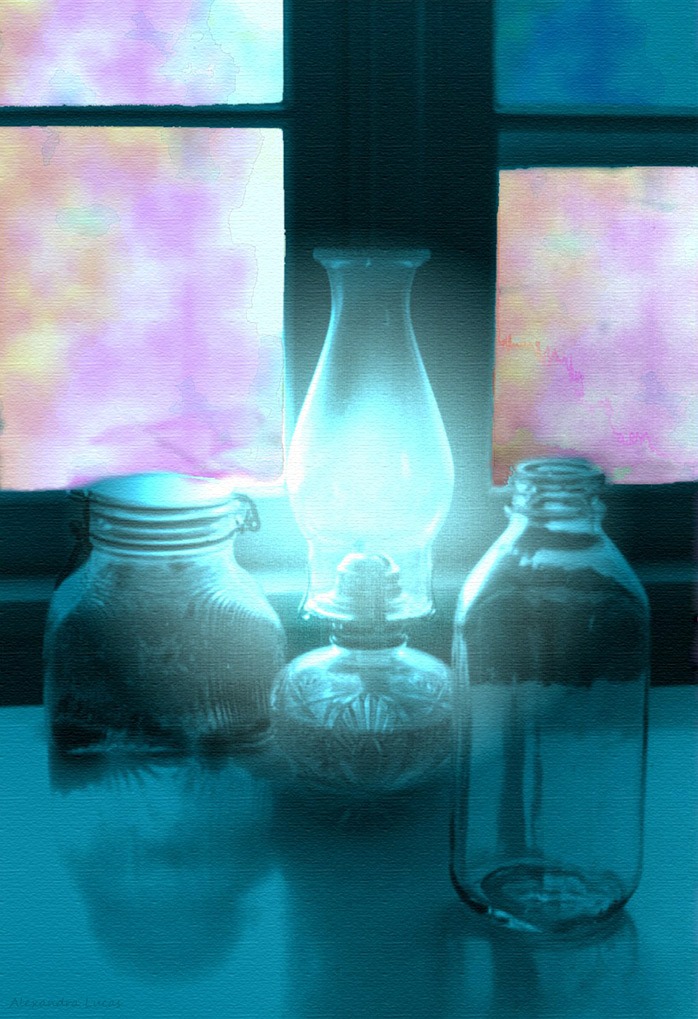
    Life became my canvas. An oil lamp kept company with a sugar jar and an empty milk bottle in a window overlooking the waves. The sun would cast light that reflected through the glass of one object into the other and it became the lighthouse for my spirit. Sea spray often turned the window into prisms.

    The importance of time shifted from alarm clocks to tides and moon phases. Not that alarms were unnecessary: they were essential. Weather reports had to be radioed in every four hours, day and night. But clocks were no longer the main measure of time. Tides dictated where and when you could leave the island. The moon dictated to the tides. And so the world became at once a much larger and much simpler place. It would take some time to find my way.

    As for art school and the creative contortions it demanded, it seemed all I had done was change the venue but this wasn’t entirely true. This was neither my classroom nor a substitute for it. This was my life and I was the work in progress. There was no turning off the lights and leaving it for another day metaphorically speaking or otherwise. The light was the all.

    This was the beginning of a completely different way of life. Romantic? Oh, yes. Terrible? Often. Lonely? Cripplingly so. Beautiful? Beyond comprehension.

    There was so much more to come on this tiny outpost in the Pacific.

  • Needs

    Needs

    Artwork based on photo by Maciej

    Needs

    So here I am walking to the store for necessities and feeling rather proud of myself for unearthing the warm coat I bought while living on the prairies. It was tucked away in my mother’s old cedar chest along with games of Life and Scruples. I needn’t have worried about finding the woolen headband after all. The sun is warm and there is no wind off the water today.

    I do wonder about the cost of things though. The store I’ve chosen is closer but the prices are higher. Sudden yapping to my right breaks my train of thought. It’s a wee dog no bigger than my boot, all puffed up, racing back and forth across the lawn at the end of his tether. One of these days, I should stop quietly in front of the house until he learns he has nothing to fear from me. But not today.

    I’m around the corner, passing the volunteer fire hall. Now Hiring is scrawled in black marker across a sheet of neon-orange bristol board taped to the front window. You know, I really should have my camera with me when I’m out and about like this. The eagle grabbing a fish from the water, dripping in gold light. Pelicans landing together in a vast inshore lake, necks entwined, wings spread against the sun. If I’d had my camera, I could have shared some of these things with you. But perhaps not. Being a witness to such things can’t be captured by anything but memory or possibly through a painting. I’m feeling a bit lighter as that slice of regret slides away.

    The store isn’t much further. A block or two has slipped past during my woolgathering. Yes, they appear to be open. The mesh window guards are pulled back and a sign is taped to the door. It reads Now in bold black marker. There must have been a sale on neon bristol board somewhere.

    Now Open. I see someone has been creative with the lettering and formed the word Open, well, openly. Block letters are formed in outline only. Before I can cross the parking lot and open the door, the other woman who lives in my head steps out from the shadows of my synapses.

    “No one can see that part of the sign. What were they thinking?” She has a tone I don’t like.

    “It doesn’t matter. You’d have to be a moron not to know the rest anyway,” I say back at her. “Someone took the time to make it nice so just shut up.”

    I’m opening the door and a faint scent of smoke greets me.

    A woman with dark, curly hair emerges from the back room.

    “Did they catch them yet?” I ask her.

    “Yes. They were just kids but I don’t remember the names.”

    I veer towards the back of the store and pick up the bread first. No prices are posted. I grab cream for my coffee and stop by the cooler up front to grab some eggs before plunking everything down at the cash register. I watch the numbers tabulate as she rings up the purchase.

    Bread is $1 more than the store at the other end of the street. Cream and eggs are $2 more. The other woman inside me is smirking.

    “You paid $3 for being too lazy to walk another half kilometer.”

    I don’t answer her. Instead, I thank the woman at the counter and leave the store with my little bag of goodies. Once outside, the smirking becomes rather more derisive so I decide to take her on once and for all.

    “Imagine,” I whisper, “there is magic afoot.”

    The woman inside my head is intrigued now and listening.

    “A young sprite is here with an offer to nip down to the other store, pick up the cheaper bread and eggs, and be back in less than the blink of an eye. It will save me the walk and he’ll do it for a $3 tip.”

    The smirk disappears. “That sounds reasonable,” she concedes.

    “That’s what happened. Magic.” I say this with confidence.

    She seems satisfied with my answer and goes back to her place in my head. I realize for the first time that she’s just looking for recognition and needs something to do with her time.

    I decide to call her Helen and make her an editor.

    We are now walking home together in companionable silence, thinking about coffee with cream.

  • Garnished with Parsley

    Garnished with Parsley

    Garnished with Parsley

    She could feel the air shift as he came up behind her. 

    “I wish you’d clean up your desk,” he said as he passed by to gaze at the french doors, beyond which his teenaged son slept. “It smells. You’ve sneezed on it.”

    She looked around, horrified that she could be working in such filth. It was entirely possible because she tended to forget about time and place when she wrote.

    But no. There was no half-empty coffee cup with cream gone off.

    There was a box that contained the startup disks for the Mac and the lid was off. There were photographs set aside for scanning, a pair of reading glasses, and his golf tournament trophy – what was that doing here? And there was the EI envelope that served as a coaster for her fresh coffee. Perhaps that was it. She smiled at her own cleverness.

    There was a pen with a liquid tip that smelled like a stationery store, all crisp with hints of possibly dangerous chemicals that promised industry. He would like that scent. In fact, if one could package the smell of pointless industry in a bottle, the man would bathe in it. There was a bottle of nail polish, Berry Delicious, but it was tightly closed.

    Her creative corner was offensive to him. She sighed. Sometimes creativity is offensive. It’s just the way things work.

    He was in the adjoining room now, sitting on the couch that had always been hers with his notebook on his lap. He’d taken up residence there for the past couple of days, like an animal marking territory. The fan was parked three feet away, oscillating back and forth, moving the humid air directly at him. He sneezed again.

    “Bless you.”

    “It’s your cat. Look at her sitting there with all that fur. No wonder.”

    She looked over her shoulder to find the cat watching her with saucer eyes. He had picked up this strange little calico a couple of years ago at the animal shelter before they’d moved in together. She wondered when the cat had become hers.

    “Bless you, again.”

    Cleanliness is next to Godliness. No one likes a slovenly girl. If you keep on writing like that, they’ll put you away, you know. Her mother’s voice was haunting her more and more these days.

    She got up and went to the kitchen for the spray bottle. The cleaner smelled like parsley and she liked it. She took her time, polishing the external hard drive to a nice sheen before returning the bottle to its place under the sink.

    “That smells good, eh.” He said it more as a statement than as a question. He was making a ham and cheese sandwich and noted they were almost out of mayonnaise.

    “Yes, it does,” she said. She got another cup of coffee as he coughed all over the cutting board.

    This time, bless you was not in order so she said nothing.

    Note: Any relation to persons living or dead is purely coincidental. Identities have been changed to protect the innocent until proven guilty.

  • Beyond Sex

    Beyond Sex

    Beyond Sex

    It’s May 14th. Many things have happened on this day throughout the years. Lina Medina becomes the youngest confirmed mother in medical history at the age of five and a Pope dies. Israel becomes a nation and forms its first provisional government. The Freedom Riders’ bus in Alabama is fire-bombed and civil rights protesters are beaten by an angry mob. The first smallpox vaccination is administered and the Netherlands surrenders to Germany.

    On this day in 2010, the sky is a particular shade of azure that happens only at this time of year. The air is filled with the scent of lilacs, the blood of sweet green shoots and dark, damp earth. It’s a heady perfume, perfectly balanced and beyond comparison with any singular thing. I breathe deeply. The sign in the window of the parfumerie on my right proudly declares the creation of a new scent – Beyond Sex. I would hope so, and I push the thoughts of dirty hotel linens from my mind and assure myself it’s probably sandalwood based. We keep walking.

    On the left, an earnest young man in wire-rimmed glasses is shoveling dark earth and raking it into what will become gardens gracing the way to the dumpsters behind the United Church. He reminds me of John-Boy. I notice he has thrown his red sweatshirt over the handles of the wheelbarrow and I wonder what year it was when red became an acceptable colour for Christians to wear. In biblical times, crimson is a colour of sin and decent people usually kept to black, white, blue and grey. You certainly don’t see the Amish in scarlet overalls. It must be that great rationalizer – moderation.

    We’ve just come out of the small corner grocery store where we bought luscious red grapes and dark roast coffee from Ethiopia. Three young men are gathered at the corner of an old brick building, laughing and shoving each other as young men do and speaking in an African language that plays like a melody. If I understood the words, perhaps it would not be so lovely but this way, it’s like birdsong. I can’t remember when it was that I learned birds are not singing, but yelling obscenities at each other over territorial disputes. My reverie continues as I pass the three-story purple house with the chandelier on the veranda. I’m not far from home now.

    I can see them up ahead. A few of the patients from the long-term care facility at the Misericordia hospital have been trotted out into the sunshine while the staff hovers over them, some dutifully, some engagingly, and some indifferently. A wheelchair is parked under a tree, holding a man in his middle years slumped forward over his blanket. His eyes are open but they appear not to see. His attendant is nearby, staring into the bark of a tree. I can’t help but think how well matched they appear to be, although I find myself hoping the man in the chair is running though the spring sunshine somewhere else in his mind. It occurs to me that we, as humans, are all about reciprocity. Otherwise, someone would be sitting with him and reading aloud. And then there are the ladies, seated around the patio like garden gnomes and being fed chocolate ice cream carefully scooped into child-size cones. One lady in particular was positively twinkling while taking in the sights and sounds of my companion. No phone, no pool, no pets. I ain’t got no cigarettes… Roger Miller recedes into the background as we pass.

    “Did you notice you were being admired?” I ask him.

    “Yes. I’ve always seemed to attract old ladies.” He gestures toward the house on the corner that had recently sold. “I do hope the new owners enjoy landscaping. It would be a shame to see these beautiful gardens disappear.”

    Apparently, he is already holding the shovel I’ve handed him.

    “Yes, it certainly would be.”

    Now what was the name of that parfumerie?

  • Jacob’s Ladder

    Jacob’s Ladder

    Jacob’s Ladder

    Patricia Maureen shook the sand out of her socks and stuffed them into her runners. “Hey, move over and give me some rock.”

    Her sister sighed and inched over to the other side of the granite slab, stuffing the towel under her to block the heat. Sun filtered through the trees, spilling across the water like forgotten diamonds. Tree frogs and cicadas were all that moved in the summer heat.

    “We are climbing Jacob’s ladder,” Mary began. Patty joined in and the two of them sang with their eyes closed against the brightness. When the words were finished they began to hum harmonies, accompanied by lazy ripples along the shore.

    Mary’s voice trailed off. She opened her eyes just a little, enough to peer through the sunlit haze down toward her feet. She didn’t move.

    “Pat,” she whispered. But Patty was floating off with the melody.

    “Pat,” she whispered again but it came out like a hiss of breath between clenched teeth. “Don’t say anything and don’t move. Trust me.”

    Mary took a long breath, her mind, body and spirit exhaling over quartz, feldspar, and mica. She was washing into the music of waves, soaring through the treetops and she could feel her sister doing the same.

    She became aware of the snake’s belly as it eased its way over her ankles but there was no fear. She was drifting. Insects sang and a warm breeze played over her skin. She wanted to remember everything.

    She could feel her sister now, absolutely still, her breath slow. Trust. Trust her. Nothing moved except the snake. The sisters stood together in eternity.

    There was no rattle, only the drone of insects watching from the trees. The cool writhing was gone. Mary opened her eyes and glanced over at her sister’s feet. Nothing.

    “I think it’s gone but don’t move yet, just in case it’s beside you.” Mary’s voice was barely audible.

    Patty followed the movement out of the corner of her eye, watching as the snake disappeared under the boulders. “It’s gone,” she said.

    They lay there together in the sun for a few minutes more before rising from the rock.

    “It wasn’t that big.”

    “No, only a couple of feet.”

    They put their socks and shoes on and stepped from the rock onto the path that led away from the water.

    “You know Maureen means little Mary, right?”

    Patty gave her sister the side eye and started singing, “I’m gonna wash that man right out of my hair.”

    Mary laughed, put her arm around her sister and sang harmony.

A Web of Lattes and Lies

Copyright © 2026 Alexandra Lucas